
Your ROI, in real time, for the first time.
Every dollar you spend and every seat it sells, on one screen the morning after. One team running the whole season behind it, and one person to call.
- 01
Signal
Who in your market buys live events, and which local businesses are shopping sponsorship.
- 02
Reach
Ads, email, SMS, phone and sponsor outreach, sequenced instead of stacked.
- 03
Respond
Every enquiry answered in seconds, day or night, in your club's voice.
- 04
Convert
Your CRM and your ticketing wired together so nobody falls through a gap.
- 05
See
One dashboard. Every dollar traced to the seat, the block or the partnership it sold.
One engine. Five stages.
Nothing here is a separate vendor, a separate invoice or a separate login. Each stage feeds the next, which is the only reason attribution works at the end of it.
Signal
Which households in your market buy live events, which local businesses are shopping sponsorship, and who is already on your ticket page and your shop.
Reach
Paid ads, email, SMS, AI voice and sponsor outreach, all pointed at the same audience, sequenced instead of stacked.
Respond
Every enquiry answered in seconds, day or night, in your club's voice. Hot ones handed to your person with the context attached.
Convert
Your CRM, your ticketing platform and your follow up sequences wired together so nobody falls through a gap between game days.
See
One dashboard across all five lines. Which channel sold which seat, which group booking, which jersey and which partnership, at what cost. Weekly reports, monthly strategy, quarterly review.
Every morning, the whole business in one email.
Not a report you go and pull. It arrives, and it is readable in ninety seconds by you and by your owners.
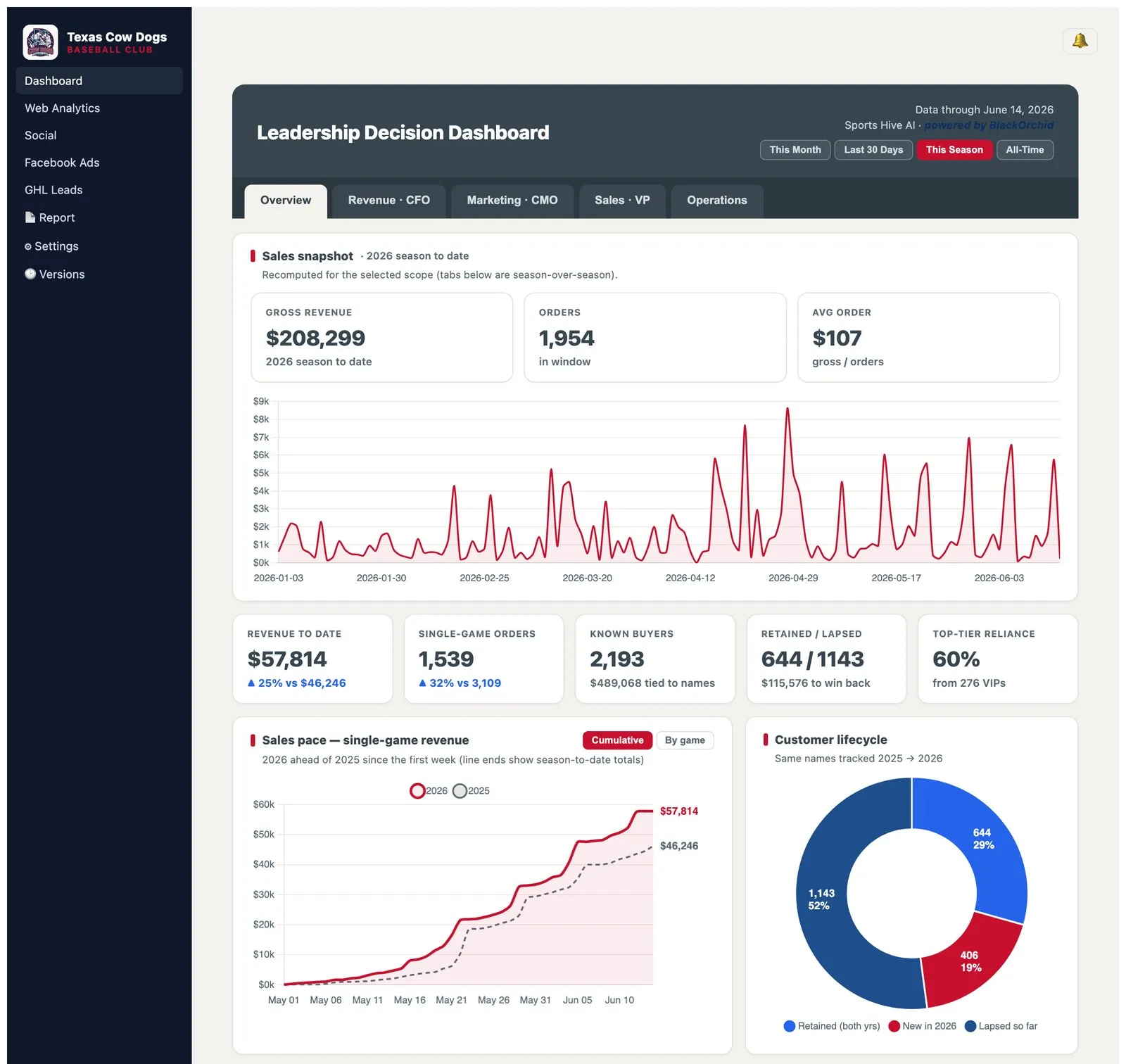
Tickets sold, day by day
The number we are measured on, not impressions.
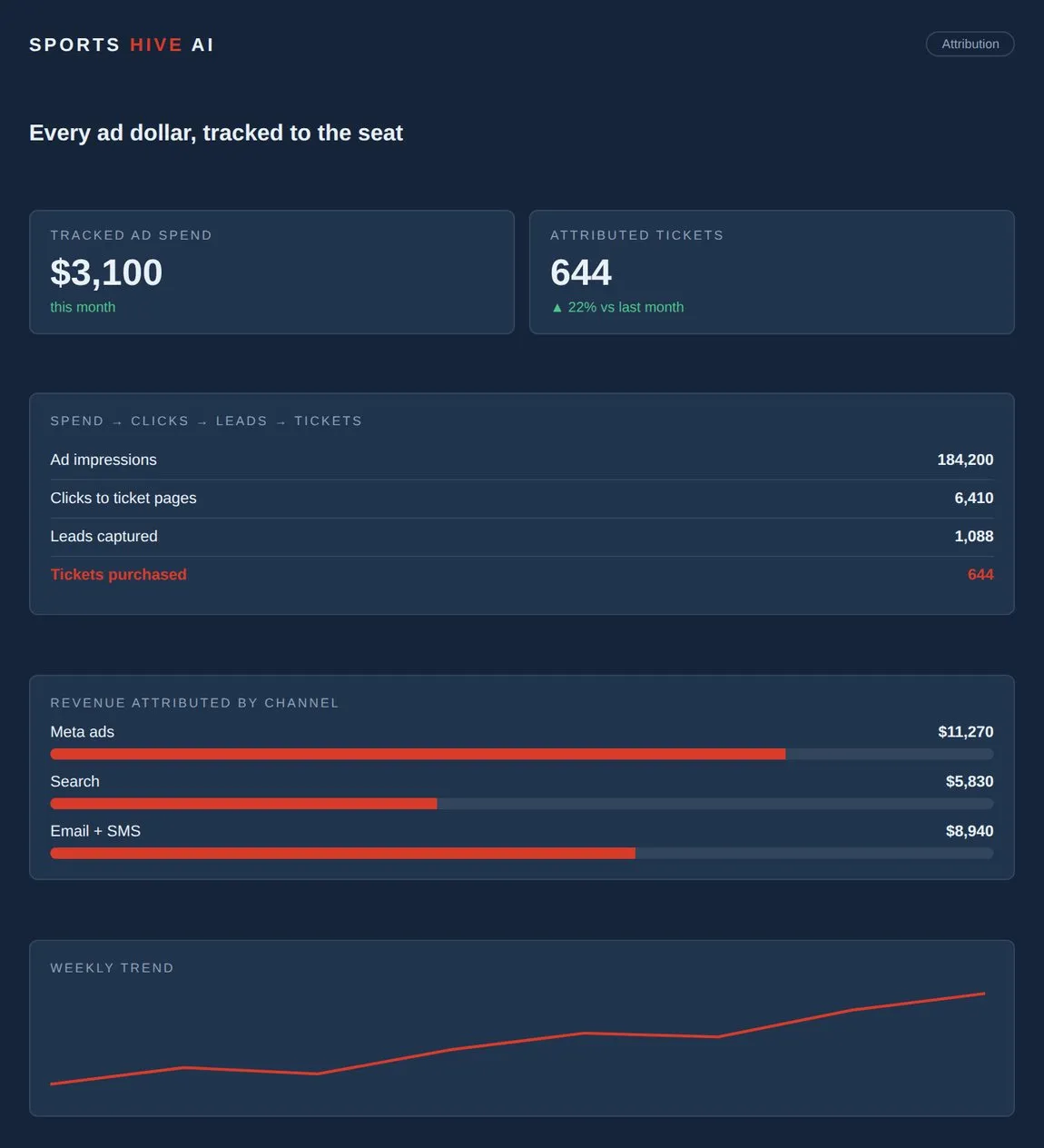
Every dollar traced
Spend against tickets, per campaign, so you can see exactly what is working.
Leads as they land
Captured, routed and followed up before anyone opens a spreadsheet.
What needs a decision
The system tells you where it is dipping and what to do about it.
The actual dashboard, shown here with demo data for a sample club. Yours is built against your own ticketing, spend and CRM during onboarding, and your owners get the same email you do.
First we find out which of your five revenue lines is leaking.
Single game, season, groups, merch, sponsorship. Before you pay us anything we look at all five, then run a live pull against your real market and show you the records. Real households, real local businesses, real intent, in your city, this week. Thirty minutes, and you keep what you learn.
What you see on the call
- Which of your five revenue lines is furthest from where it should be
- The size of the verified household pool in your metro
- How many of them showed live event or family entertainment intent in the last seven days
- Local businesses currently showing sponsorship and advertising intent
- What your ticket page traffic looks like once it is identified
We throw most of it away
A raw pull returns far more than anyone should call. Most of it does not survive our filters, and what does not survive never reaches your CRM. What we put on the screen is what is left after that, which is the only number worth talking about.
The diagnosis is free. No card, no obligation, and if your market will not carry the system we will tell you that instead of selling you a season.
Two audiences. One engine.
A club sells to two completely different rooms. Families deciding what to do on a Friday, and businesses deciding where their marketing budget goes. Most teams run one set of ads at an age range and a zip code and hope it covers both. It does not.
So the Audience Engine builds both. On the fan side, verified households in your market who showed interest in live events and family entertainment in the last week: parents with kids at home, households with the income to say yes, people already shopping for exactly the night out you sell. On the business side, local companies showing live advertising and sponsorship intent, with the decision maker named.
Then the same two audiences power everything. Your ads reach them, your emails speak to them, your texts remind them, your sponsor outreach lands on the right desk, and your dashboard shows what each one bought.
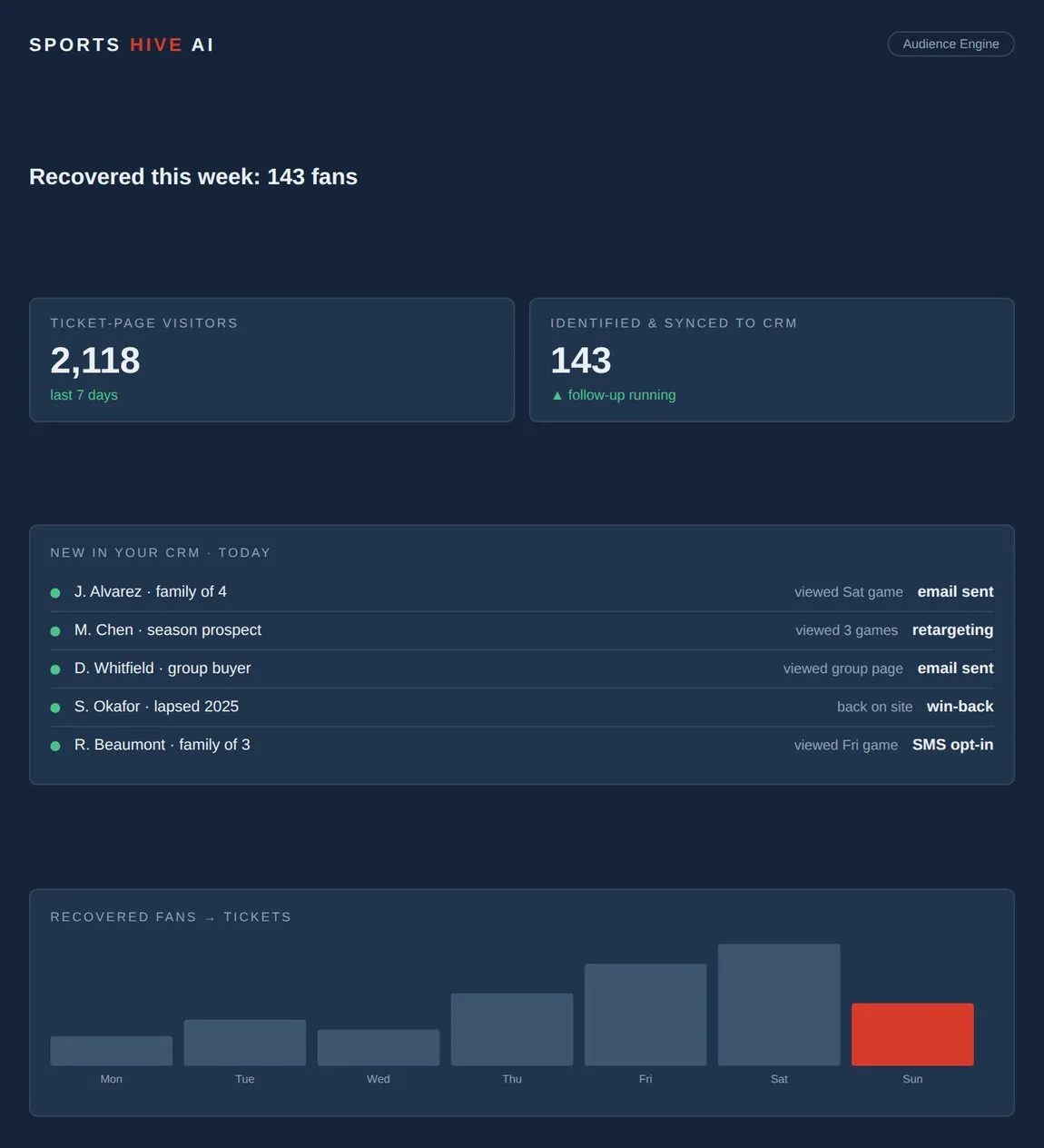
Real behaviour, not demographics
Fan audiences built from recent real world spending in your market, not "adults 25 to 54". We don't advertise at everyone.
Anonymous visitors, identified
Most people who visit your ticket page or your shop leave without a trace. Our identity pixel resolves around 60% of them into real contacts your system can follow up with automatically.
Your old lists, brought back to life
We enrich past ticket holders, lapsed accounts and old shop customers with current, verified contact and household data, then run win back campaigns segmented by family, interest and spending power.
Sponsors, sourced not remembered
Local, regional and national companies showing live advertising and sponsorship intent, with the person who signs it named. Your pipeline stops being one person's contact list.
Precision audience targeting and visitor identification are available for United States based organizations. Every other part of the system, the campaigns, the CRM, the AI follow up, the phone agent, the sponsor outreach and the attribution, works for teams anywhere.
Five ways your club makes money.
Most agencies show up to work on one of these and call it marketing. All five run on the same audience, the same CRM and the same dashboard, which is the only reason you can see which one is actually paying.
Single game tickets
Season tickets
Groups, corporate nights and parties
Merchandise
Corporate sponsorship, local to national
You do not have to want all five. Most clubs start with the two that hurt most, and the engine picks up the rest as the season goes.
We hand you your future clients by name.
Not a list you bought. Every week we scan your market, read your own partner page, read the competing property's partner page, and come back with the companies and the organizations that should already be buying from you, ranked and routed with the warm path in.
Which categories in your market have nobody selling them.
- The named decision maker in each one, not a company record
- Renewal timing, so you call when the budget is actually open
- Who already sponsors the other property in town and not you
- The lists that already exist inside your building that nobody has worked
Who can fill seats without buying a sponsorship at all.
- Schools, employers, faith, youth, civic, nonprofit, agents and higher education
- Seat counts per organization from their own published headcount
- The nights already on your calendar that were never packaged or priced
- A sponsor conflict does not block a group. A group just buys a night
Almost nobody is starting from zero. Most clubs already have the matinee, the faith night, the youth night and the community expo sitting on the calendar. What they do not have is a single published price, minimum or package anywhere. The inventory is already there. Nobody packaged it, priced it, or sold it.
Figures above are from a real scan run in one North American market in August 2026, shown with the club and the companies unnamed. Yours are your own, and the first ones land before you have paid us anything.
AI where it earns its keep. People where it matters.
AI is very good at the parts of a sales operation that never sleep and never scale. It is not good at deciding what your club stands for. We split it exactly there.
What the AI does
- Answers enquiries in seconds, at midnight, on a game day, in your voice
- Works the phone for renewals and lapsed accounts, then logs every call
- Reads the response data and reallocates spend toward what is selling
- Builds and refreshes audiences continuously instead of once a season
What we will not do
- Point a bot at your club's social accounts and let it write
- Generate graphics nobody approved
- Hand a language model your brand and hope
- Replace your staff with a chatbot and call it transformation
A person on our side owns your account, your offers and your guardrails. You approve creative before it runs.
The part nobody else puts in writing.
Most of what separates agencies at this level is not the software. It is what happens in the weeks after the contract is signed, so here is ours, before you sign one.
Realistic ranges, never guarantees
We give you the range our plan is built around and the assumptions under it. Anyone promising a number has not seen your calendar.
Account warm up and health monitoring
Sending domains and phone numbers are warmed properly and watched weekly, because deliverability is the whole campaign.
Monthly ICP review
Who we are targeting is revisited every month against what actually converted, not set once in onboarding.
Biweekly copy testing
New angles every two weeks. Losers get retired, winners get scaled, and you see both.
A positive reply SLA
We commit to a response standard in writing and report against it, including the weeks we miss.
Full CRM handoff
The CRM, the ad accounts and every contact are yours. If you leave, you leave with all of it. No lock in, no export fee.
Terms of service risk disclosed upfront
Where a channel carries platform risk, you hear it from us before we run it, not after an account gets flagged.
Multi channel layering
Ads, email, SMS, phone and sponsor outreach in sequence. One channel repeated louder is not a system.
What kind of club are you?
Minor league and junior clubs: too big to run on volunteers, too small to justify a sales department.
The engine is not sport specific. The same five stages run a hockey winter, a baseball summer and a basketball season, and the only thing that really changes is the calendar and who the group buyers are in that town. So if your sport is not on this list it is a conversation, not a no.

Hold the button. Fill the building.
This is the only number anyone in your front office actually argues about. Press and hold, and watch what a full night looks like.
Now do that every home game. That is the whole job.
Eight things running together, and one person to call.
Most clubs already pay somebody for a piece of this. An outbound vendor sends the emails. An agency runs the ads. Nobody owns the number at the end. Here is everything a season actually needs, and it sits with one team and one name in your phone.
One person. Not a ticket queue and not a new account manager every quarter.
You get a named lead on our side who knows your calendar, your prices and your building. Same person on the weekly call, same person when something breaks on a game day, same person your owners meet. Everything below runs behind them, so you are never the one chasing four suppliers to find out who dropped it.
A weekly reporting call, a monthly strategy call, and a reply inside one business day. That is the standard we hold ourselves to and report against, including the weeks we miss it.
Outbound email campaigns
Multi-touch sequences to scored prospect lists, from a warmed sending domain.
Creative produced game to game
Static, video and copy variants refreshed weekly against what is converting.
Replies handled, meetings booked
We answer, qualify and put the meeting on your rep's calendar.
Sponsor deep dives every week
Named decision makers, renewal timing, open categories and the warm path in.
LinkedIn outreach in your sectors
Connection and message sequences in the categories that actually buy in your market.
Tickets and spend, one dashboard
Seats sold against every dollar, updated daily, readable by your owners.
Paid ads built every home game
Launched against each on-sale and optimised in flight, not set and left.
Your CRM, run and kept clean
Pipeline stages, follow-up tasks and routing, with nothing sitting untouched.
It is not the same job for less. At most clubs nobody is currently doing six of these at all, and the eight only work when one team runs them together. That is the whole argument, and it is why the next section is about scope before it is about price.
Or you could buy the pieces.
To run all five revenue lines properly you need four different suppliers. Here is what that stack costs.
None of the numbers below are ours. This is what the market charges for each piece if you go and buy them separately. Our own pricing sits further down, under What you get.
| The supplier you'd hire | What that one covers | What they charge you |
|---|---|---|
| Marketing agency | Ads and creative. No data, no CRM, no sponsorship. | $5,000 to $10,000/mo |
| Analytics and dashboard firm | Reporting only. Someone else still has to sell. | $20,000 setup, then $8,000/mo |
| Data vendor | A list. Nobody works it. | $1,000 to $2,000/mo |
| Sales and sponsorship hire | Outreach, and only if you feed them leads. | $150,000+/yr, about $12,500/mo |
| All four, every month | Four invoices, four logins, four people to chase | $26,500 to $32,500/mo |
| Year one, with the dashboard setup | Before a single ad has run | $338,000 to $410,000 |
Third-party market estimates for each category, not quotes and not our rates. We publish them because a club comparing us usually has one of these four lines in mind, when the honest comparison is all four together.
Our price is not on that table.
Sports Hive AI is deliberately not a row up there, because our number is not a rate card. It is a one time setup and a flat monthly for your season, quoted against the size of your market and your building, and you see it in writing before anything is signed. The point of the table is what you are comparing us to. Not one agency line, but all four of those suppliers added together, with four invoices and nobody in the middle accountable for fans in seats.
One engine. All of it.
There is no starter version. Tiers meant selling a club half a system and calling it a beginning, and half a system cannot show you which channel sold which seat. Every club gets the whole engine: tickets, merchandise, renewals and sponsorship, running together on one audience.
Your whole front office, for one monthly partnership.
Audience and data
- Hive Audience Engine build for your market
- Intent audiences refreshed continuously, not once a season
- Website visitor identification on your ticket pages
- Past ticket holders, lapsed accounts and shop customers enriched, then worked
- Sponsor prospecting from live business buying signals
All five revenue lines
- Single game campaigns, built game by game and around each theme night
- Season ticket renewals started before the deadline, and new season nurture
- Group, corporate night and party outreach with a real booking path
- Merchandise campaigns aimed at people who already hold a ticket
- Sponsorship prospecting from live business buying signals, local to national
- Ads, email, SMS and an AI voice agent carrying all of it
Systems
- Custom CRM and branded dashboard
- Landing pages, sequences and ad creative
- Ticketing platform integration
- Conversion tracking on every channel
- All of it in your name, yours to keep
Accountability
- Weekly performance reports
- Monthly strategy calls
- Quarterly business reviews
- Continuous creative and copy testing
- A positive reply standard, in writing
A one time setup covering discovery and build, then a flat monthly for the season. The amount depends on the size of your market and your building, and we put it in front of you before anything is signed. Ad spend is funded separately into your own ad account, and we recommend a minimum of $3,000 a month during the active season. No per lead fees, no per ticket fees, no commission. Commitment runs per season, typically eight to twelve months, because the system needs a full cycle to compound.
The numbers we plan around.
Where the numbers come from
Every ticket traces back to the ad, the email, the text or the call that sold it. That is the report behind these figures, and it is the same one you get every week.
These are planning models built from our pilot clubs, not a promise and not a floor. What your season looks like depends on your market, your price and your calendar. The diagnosis is where we find out which of those you are working with.
Straight answers.
How is your ad targeting different from what our last agency did?
Most agencies target age ranges and locations inside the ad platform and let the algorithm guess. We build the audience before the platform ever sees it, from verified consumer profiles and buying behaviour in your market that is refreshed weekly. Your budget lands on people showing real interest in a night out, which is why a modest ad spend goes further with us.
What does identifying website visitors mean?
The overwhelming majority of people who visit your ticket page leave without buying, and normally you never know who they were. We place an identity pixel on your site that matches around 60% of that traffic to verified contact profiles. Those fans flow into your CRM automatically and get a follow up: a retargeting ad, an email, or a text if they have opted in.
Does this work outside the United States?
Precision audience targeting and visitor identification are available for United States organizations today. Everything else, the ads, email, SMS, CRM, dashboard, AI phone agent and sponsor outreach, works for clubs anywhere. If you are outside the US we will tell you on the diagnosis call exactly which part of the stack changes and how we build audiences instead.
Is this compliant?
Yes. The data comes from verified, permissioned consumer sources, texts only go to fans who have opted in, and every campaign follows CAN-SPAM and TCPA requirements. You own your CRM and every contact in it.
What does it cost?
A one time setup fee covering discovery and build, then a flat monthly for the season. The amount depends on the size of your market and your building, and we detail it before anything is signed. Ad spend is separate and goes into your own account, and we recommend a minimum of $3,000 a month during the active season.
We need help with sponsorship more than tickets. Does that change anything?
No, it changes which half of the engine works hardest. Sponsorship runs on business buying signals rather than household data: we build the prospect list from local, regional and national companies showing live advertising and sponsorship intent, name the person who signs, and warm them up so your person walks into a conversation instead of a cold call. The reporting matters just as much, because an activation that can show what it delivered is the one that renews without a negotiation.
Do you work on merchandise and group sales too, or just tickets?
All five lines: single game, season, groups and corporate nights, merchandise and sponsorship. They share one audience, one CRM and one dashboard, which is the point. Group nights usually move the most tickets per conversation and get the least attention, and merch is almost always sold to people who already hold a ticket, so running them separately from your ticket campaigns wastes both.
Do you have a smaller package we could start with?
No. There is no starter version, and that is deliberate. The reason this works is that the audience, the channels, the CRM and the attribution are one system, so a smaller slice cannot tell you which channel sold which seat. If the full engine is not right for your club yet, the diagnosis will show that and we will say so.
What happens if we leave?
You take everything. The CRM, the ad accounts, the audience lists and every contact are yours from day one. There is no export fee and no vendor lock in.
How long until we are live?
Roughly 30 days from kickoff, because build overlaps discovery. Discovery runs weeks one and two, build runs weeks two to six, and launch usually lands around week five.
What do you need from us?
Brand assets, ticketing platform access, prior sales data and your game calendar up front. After launch, five to ten minutes a day for hot lead handoffs and about thirty minutes a week for review.

Tell us what you sell. We'll show you who's buying it.
Thirty minutes on your real market and all five revenue lines, before you have paid us anything.
Book the diagnosis